Fixed Ball Valve Fire Safe Design Overview: Standards, Features, Advantages & Specifications
Fixed Ball Valve Fire Safe Design Overview
A fixed ball valve with fire safe design is a critical safety component in modern
oil and gas, petrochemical, chemical, power generation and general industrial piping systems.
This article provides a detailed and SEO‑oriented overview of the
fire safe design of fixed ball valves, including working principles, design
features, applicable standards, testing requirements, advantages and typical specification data.
- definition”>Definition of Fixed Ball Valve and Fire Safe Design
principle”>Working Principle of a Fixed (Trunnion Mounted) Ball Valve
fire-safe-concept”>Fire Safe Design Concept for Ball Valves
standards”>Main Fire Safe Standards for Fixed Ball Valves
design-features”>Key Fire Safe Design Features
materials”>Typical Materials and Construction
benefits”>Advantages of Fire Safe Fixed Ball Valves
applications”>Typical Applications and Industries
spec-table”>Typical Technical Specifications Table
selection”>Selection Guidelines for Fire Safe Fixed Ball Valves
installation”>Installation and Maintenance Considerations
faq”>FAQ on Fire Safe Fixed Ball Valves
1. Definition of Fixed Ball Valve and Fire Safe Design
1.1 What Is a Fixed Ball Valve?
A fixed ball valve, commonly called a
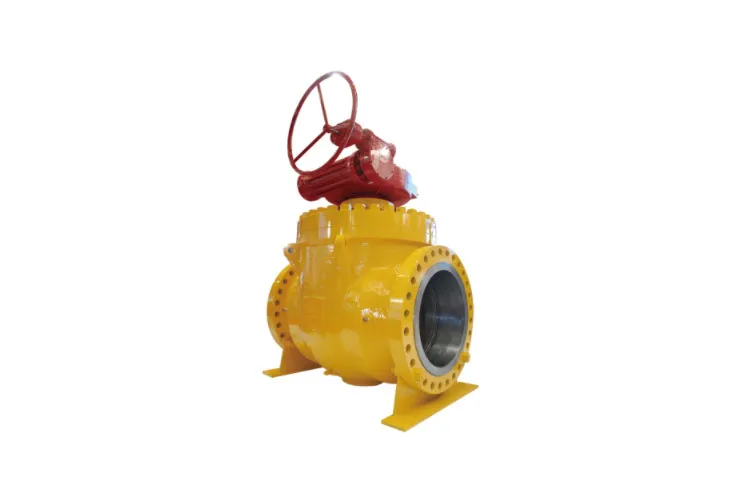
trunnion mounted ball valve, is a quarter‑turn shut‑off valve in which
the ball is held in a fixed position by trunnions (upper and lower stems or journals).
The line pressure pushes the seat rings against the ball to achieve tight sealing.
In contrast to a Floating ball valve, in a fixed ball valve the ball itself does not
move axially under pressure. The seat rings are spring‑loaded or pressure‑assisted
to maintain contact with the ball. This configuration is widely used for:
- Medium to large diameter pipelines
- High pressure services
- High differential pressure conditions
- Critical isolation in hazardous fluid systems
1.2 What Is Fire Safe Design for Ball Valves?
Fire safe design refers to a construction concept for valves that ensures
the valve can still provide a minimum level of sealing during and after exposure to a fire.
A fire safe fixed ball valve is designed so that:
Fire safe design does not mean the valve is indestructible; instead, it means that
leakage is controlled to a safe, predefined level during and after a fire
scenario, protecting people, property and the environment.
2. Working Principle of a Fixed (Trunnion Mounted) Ball Valve
2.1 Basic Operation
A fixed or trunnion mounted ball valve is a quarter‑turn valve:
- When the handle or actuator rotates the ball 90°, the valve changes from fully open to fully closed, or vice versa.
- The ball is supported by the upper and lower trunnions/stems and is constrained from axial movement.
- Seat rings are energized by springs or line pressure to maintain tight contact with the ball.
Because the ball is fixed, operating torque is lower than in floating ball valves under
high pressure, and sealing performance is more reliable for larger sizes.
2.2 Main Components
Although designs vary, a typical fixed ball valve consists of:
- Body (one‑piece, two‑piece or three‑piece)
- Ball (fixed by trunnions)
- Upper stem (drive stem)
- Lower trunnion
- Spring‑loaded or pressure‑energized seat rings
- Stem seals and packing
- Body gaskets
- Anti‑static devices
- Fire safe secondary metal seals
- Actuator interface (lever, gear, pneumatic or electric actuator)
2.3 Difference Between Fixed and Floating Ball Valves
Feature |
Fixed (Trunnion Mounted) Ball Valve |
Floating Ball Valve |
Ball Support |
Supported by trunnions at top and bottom; ball is fixed axially. |
Ball is held by seats and stem; moves slightly downstream under pressure. |
Seat Design |
Seats are spring‑loaded or pressure‑energized, move towards ball. |
Seats are generally fixed; ball moves to press against downstream seat. |
Typical Size Range |
Medium to large diameters (DN50 and above, typically up to DN1200 or larger). |
Small to medium diameters (up to around DN300–DN400, depending on design). |
Operating Torque |
Lower torque at high pressure due to balanced ball support. |
Higher torque at high differential pressure. |
Typical Pressure Class |
Suitable for medium to very high pressure (Class 150 up to Class 2500). |
Commonly Class 150–600, sometimes higher but less typical. |
Applications |
High pressure pipelines, trunk lines, critical isolation, subsea, LNG. |
General purpose isolation, utility lines, low to medium pressure services. |
3. Fire Safe Design Concept for Ball Valves
3.1 Purpose of Fire Safe Design
The purpose of fire safe design in a fixed ball valve is to:
- Limit the escape of flammable or toxic media during a fire.
- Maintain pressure boundary integrity as long as reasonably possible.
- Provide a secondary sealing mechanism when soft seals are destroyed.
- Reduce the risk of fire escalation and environmental contamination.
Many process plants, offshore platforms, tank farms and pipeline installations require
fire tested and fire safe certified ball valves in order to comply with
safety regulations, insurance requirements and international standards.
3.2 Fire Scenario Considered
Fire safe standards for fixed ball valves assume a realistic fire scenario:
- High temperature flames enveloping the valve for a defined period (usually 30–60 minutes).
- Rapid temperature rise leading to burning or melting of non‑metallic components.
- Possible thermal shock due to sudden cooling, for example when fire fighting water is applied.
Under these extreme conditions:
3.3 Primary vs Secondary Sealing
In a typical fire safe fixed ball valve design:
- Primary seal: Soft materials (PTFE, RPTFE, PEEK, elastomers, graphite‑filled
compounds) are used for low operating torque, bubble‑tight shut off, and corrosion resistance
under normal operating conditions.
- Secondary seal: Metallic contact surfaces, often supported by fire resistant
graphite seals, create a backup seal when the primary soft materials are destroyed by fire.
This dual sealing philosophy is one of the key aspects of fire safe ball valve design.
4. Main Fire Safe Standards for Fixed Ball Valves
Several international standards describe how to design and test
fire safe ball valves. For fixed (trunnion mounted) ball valves,
the most commonly referenced standards include:
4.1 API 607
API 607 is a widely used fire test standard for
quarter‑turn valves and other valves with non‑metallic seat and
seal materials. Although originally applicable to soft‑seated valves up to a certain size,
it has been broadly adopted as a reference for fire safe testing of
fixed ball valves in many industries.
API 607 specifies:
- Fire temperature and duration.
- Valve pressurization requirements during fire.
- Allowable internal and external leakage rates.
- Cooling and post‑fire test procedures.
4.2 API 6FA
API 6FA is the fire test standard specifically oriented to
valves used in petroleum and natural gas pipeline and production systems.
Many fixed ball valves for pipeline service are tested according to API 6FA.
Compared with API 607, API 6FA focuses more on high pressure applications and larger sizes,
which are typical for trunnion mounted ball valves in critical pipeline duties.
4.3 ISO 10497
ISO 10497 is an international standard for
testing of valves — fire type testing requirements. It is broadly
equivalent in intent to API fire test standards but developed as part of the ISO framework.
Many global projects allow compliance with ISO 10497 as evidence of
fire safe design.
4.4 Other Relevant Standards and References
4.5 Fire Safe vs Fire Resistant
In industry terminology, fire safe valves are those that have been
successfully tested according to a recognized fire test standard
and comply with leakage limits. The term fire resistant may refer more loosely
to materials or designs that have good resistance to high temperatures, but this
does not necessarily guarantee full compliance with a standard fire test.
5. Key Fire Safe Design Features
5.1 Fire Safe Seat Design
The design of the seat assembly is critical for a
fire safe fixed ball valve. Key characteristics include:
- Soft sealing material (PTFE, RPTFE, PEEK, etc.) for normal operation,
located in a recess in the metal seat ring.
- Metal seat ring lip that is capable of contacting the ball directly
when the soft seat material has disappeared due to fire.
- Spring or pressure energizing mechanism that presses the seat ring
towards the ball, both in normal and post‑fire conditions.
- Optional graphite insert or metal‑graphite composite seal behind the
seat to enhance fire performance.
During a fire, as the soft material burns, the seat ring travels further towards the ball,
allowing metallic contact to form the secondary seal.
5.2 Fire Safe Stem Sealing
The stem seal is another critical leakage path.
Fire safe fixed ball valve designs typically use:
- Multiple rings of packing, often combining graphite with other
high temperature materials.
- Secondary O‑rings or lip seals for normal low‑torque sealing.
- A backseat feature that allows the stem to seat against the bonnet
or body in a metal‑to‑metal contact during fire, reducing external leakage.
Graphite packing is commonly used because of its excellent fire resistance
and capability to maintain sealing at elevated temperatures.
5.3 Fire Safe Body and Bonnet Joints
For two‑piece and three‑piece body fixed ball valves, the body joints
are potential external leakage paths during fire. Common fire safe design solutions include:
- Spiral wound gaskets with graphite filler for body joints.
- Metal‑to‑metal contact shoulders that come into contact if the gasket
is destroyed by fire.
- Careful design of gasket groove geometry to ensure compression and secondary sealing
after fire exposure.
5.4 Anti‑Static and Blow‑out Proof Design
Although not exclusively a fire safe feature, anti‑static devices and
blow‑out proof stem design are commonly integrated in fire safe fixed ball
valves to address additional safety aspects:
- Anti‑static spring or ball devices ensure electrical continuity between ball, stem and body,
preventing static charge accumulation that could ignite flammable fluids.
- Blow‑out proof stems are inserted from the inside of the valve body and cannot be expelled
by internal pressure, even when gland components are damaged.
5.5 Fire Safe Operation Under Automation
Many trunnion mounted fire safe ball valves are operated by
pneumatic or electric actuators. For fire safe performance:
6. Typical Materials and Construction
6.1 Body and Ball Materials
The body and ball materials for fire safe fixed ball valves must withstand
high pressures, corrosion and elevated temperatures. Common materials include:
- Carbon steel (e.g., ASTM A105, A216 WCB) for general oil and gas pipeline service.
- Low temperature carbon steel (e.g., ASTM A350 LF2) for cryogenic or low temperature duty.
- Stainless steel (e.g., ASTM A351 CF8M, A182 F316) for corrosive media or offshore environments.
- Duplex and super duplex stainless steels for aggressive chloride‑containing environments.
- Alloy steels and nickel‑based alloys for high temperature or highly corrosive services.
6.2 Seat and Seal Materials
Typical soft seat and seal materials for fixed ball valves include:
- PTFE (Polytetrafluoroethylene) and reinforced PTFE (RPTFE).
- PEEK (Polyether ether ketone) for higher temperature and pressure capabilities.
- Nylon or other engineered plastics for specific media or temperature ranges.
- Elastomeric O‑rings (Viton, NBR, HNBR, FKM, etc.) for stem and body seals.
- Graphite rings and packing for fire resistance, especially in stem and body joints.
For fire safe ball valves, elastomers and plastics are carefully selected
to balance sealing performance with thermal resistance up to the anticipated service conditions.
6.3 Fire Safe Metal‑to‑Metal and Graphite Components
To ensure secondary sealing in a fire, the following materials are often used:
For severe service, metal‑seated fire safe ball valves may be specified with
hard coatings (such as tungsten carbide or chrome carbide) on the ball and seats.
6.4 Coatings and Surface Treatments
Fixed ball valves used in fire hazardous environments often include protective coatings:
- External painting or powder coatings for corrosion resistance.
- Internal coatings or overlays for specific media (e.g., corrosive gases or slurries).
- NACE‑compliant materials and treatments for sour service (H2S containing environments).
7. Advantages of Fire Safe Fixed Ball Valves
7.1 Enhanced Safety
The primary advantage of a fire safe fixed ball valve is improved safety:
- Reduced risk of uncontrolled leakage during fire.
- Mitigation of fire escalation by limiting fuel release.
- Protecting personnel, process equipment and the environment.
7.2 Regulatory and Standard Compliance
Many industrial facilities and pipeline systems require
fire tested ball valves to meet:
- National and international safety regulations.
- Project‑specific specifications (often referring to API 607, API 6FA, ISO 10497).
- Insurance and risk management policies.
7.3 High Reliability in Critical Service
Fixed (trunnion mounted) ball valves with fire safe design offer:
- Reliable sealing at high pressures and large diameters.
- Lower operating torque and better control with actuators.
- Stable performance across a wide range of temperatures and media.
7.4 Long Service Life and Reduced Maintenance
When correctly specified and installed, fire safe fixed ball valves can
deliver long service life with:
- Durable metal body and ball materials.
- Replaceable seat and seal components in many designs.
- Predictable maintenance intervals and lower total cost of ownership.
8. Typical Applications and Industries
8.1 Oil and Gas Production and Transportation
Fire safe fixed ball valves are widely used in:
- Onshore and offshore oil and gas production facilities.
- Gathering lines, trunk lines and export pipelines.
- Block valves in pipeline networks and compressor stations.
- Crude oil, gas and multiphase flow applications.
8.2 Refining and Petrochemical Plants
In refineries and petrochemical complexes, many process units handle:
- Highly flammable hydrocarbons.
- Toxic and hazardous chemicals.
- High temperature and high pressure media.
Fire safe fixed ball valves are typically specified for:
- Unit block valves.
- Tank inlet and outlet isolation.
- Flare systems and emergency shutdown systems.
8.3 Chemical and Power Generation Industries
In chemical plants, power plants and industrial utilities,
fire safe ball valves are used where:
- Potential fire hazards exist due to flammable gases or liquids.
- Critical isolation is required for safety systems.
- Compliance with process safety management (PSM) is essential.
8.4 Marine, LNG and Storage Terminals
Fire safe fixed ball valves are also found in:
9. Typical Technical Specifications Table
The following table summarizes typical specification ranges for
fire safe fixed ball valves. Actual values depend on the specific design,
material selection, applicable standards and project requirements.
Parameter |
Typical Range / Options |
Notes |
Valve Type |
Fixed (trunnion mounted) ball valve |
Quarter‑turn, fire safe design. |
Nominal Diameter (DN) |
DN 50 – DN 1200 (2″ – 48″) or larger |
Sizes smaller than DN 50 are also available, but trunnion design is most common for medium to large sizes. |
Pressure Class |
ASME Class 150 – Class 2500 |
Common application ranges: 150/300/600/900/1500/2500. |
End Connections |
Flanged (RF, RTJ), Butt Weld, Socket Weld, Threaded |
Pipeline valves are often butt weld or flanged; RTJ used for high pressure. |
Body Construction |
One‑piece, two‑piece, three‑piece |
Three‑piece body may facilitate maintenance; two‑piece common for pipeline valves. |
Body Materials |
Carbon steel, low temperature carbon steel, stainless steel, duplex, alloy steel |
Material selected based on pressure, temperature and media corrosion characteristics. |
Ball Material |
Stainless steel, carbon steel with overlay, duplex, special alloys |
Often hard‑faced or coated for improved wear and fire performance. |
Seat Type |
Soft‑seated (PTFE, RPTFE, PEEK) with fire safe metal‑to‑metal backup |
Metal‑seated options available for severe or high temperature service. |
Fire Safe Certification |
API 607, API 6FA, ISO 10497, BS 6755 part 2 (legacy) |
Project specifications typically designate the required standard. |
Temperature Range |
Approx. -196 °C to +425 °C (depending on materials) |
Cryogenic designs require special seats and extended bonnets; high temperature uses graphite seals and metal seats. |
Leakage Class |
Bubble‑tight (zero visible leakage) under normal conditions |
Leakage classification may reference ISO 5208 or API 598 for non‑fire conditions. |
Operation |
Manual lever, gear operator, pneumatic actuator, hydraulic actuator, electric actuator |
Fixed ball valves are often automated for remote or emergency shutdown. |
Design Standards |
API 6D, ISO 14313, ASME B16.34, EN standards |
Selection depends on region and application (pipeline, process, etc.). |
Testing |
Hydrostatic shell test, seat test, low‑pressure air test, fire test, fugitive emissions test (if required) |
API 598, API 6D and ISO 5208 testing practices are commonly used. |
Sealing to Atmosphere |
Graphite packing, O‑rings, fire safe body gaskets |
Optional low fugitive emission packing in accordance with ISO 15848 or API 641. |
Special Options |
Double block and bleed, emergency sealant injection, extended stem, locking devices |
Chosen based on piping layout, safety and maintenance strategy. |
10. Selection Guidelines for Fire Safe Fixed Ball Valves
10.1 Define Service Conditions
When selecting a fire safe fixed ball valve, consider:
- Design pressure and operating pressure.
- Design temperature and operating temperature.
- Type of fluid (gas, liquid, multiphase, slurry, corrosive, toxic, flammable).
- Required flow capacity and valve size.
- Line connection type and layout constraints.
10.2 Compliance with Standards and Regulations
Selection should always align with:
- Applicable design standards (API 6D, ASME B16.34, ISO standards).
- Fire test standards (API 607, API 6FA, ISO 10497).
- Local safety laws, codes and insurance requirements.
10.3 Seat and Seal Selection
Choose seat and seal materials based on:
- Chemical compatibility with the medium.
- Operating temperature and pressure range.
- Required shut‑off class and cycle frequency.
- Special requirements such as low‑temperature or high‑temperature operation.
10.4 Manual vs Automated Operation
For critical safety functions, actuated fixed ball valves are often preferred:
- Automatic shutdown in response to fire or process alarms.
- Remote operation for hazardous or inaccessible areas.
- Integration into plant control and emergency shutdown systems.
10.5 Additional Fire Safety Considerations
In addition to valve design, the overall system must consider:
- Fire proofing of supports and actuators when required.
- Drain and vent arrangements to safely depressurize lines.
- Use of double block and bleed configurations where zero line leakage is critical.
11. Installation and Maintenance Considerations
11.1 Installation Best Practices
Proper installation is vital for the performance of a
fire safe fixed ball valve:
- Ensure correct orientation when flow direction is specified.
- Use appropriate gaskets and apply the correct bolting torque at flanged joints.
- Verify proper alignment of the pipeline to avoid excessive stress on valve body.
- Install supports to prevent vibration and mechanical overloading.
- Confirm actuator stroke adjustment and limit switch settings where actuated.
11.2 Commissioning and Testing
Before placing a fire safe ball valve into service:
- Perform pressure tests according to the relevant standard (API 598, API 6D, ISO 5208).
- Cycle the valve several times to verify smooth operation.
- Check for external leakage at the stem and body joints.
- Validate the correct function of any emergency shutdown or interlock systems.
11.3 Routine Inspection and Maintenance
Routine maintenance activities may include:
- Visual inspection for corrosion, damage, or external leakage.
- Torque check and occasional manual cycling to prevent sticking.
- Inspection of actuator and control accessories (solenoid valves, limit switches, positioners).
- Replacement of packing or seals after extended service or when leakage is detected.
Fire safe features such as graphite packing and metal‑to‑metal seats should also be
inspected during overhaul or major shutdowns.
12. Frequently Asked Questions (FAQ) on Fire Safe Fixed Ball Valves
12.1 Does a Fire Safe Ball Valve Prevent All Leakage in a Fire?
A fire safe fixed ball valve is designed to limit
leakage during and after a fire to specified maximum values defined in the fire test standard.
It does not guarantee absolutely zero leakage under fire conditions, but aims to reduce leakage
to a level that minimizes the risk of fire escalation.
12.2 How Do I Know If a Ball Valve Is Fire Safe?
A valve is considered fire safe when:
12.3 Is Fire Safe Design Required for All Ball Valves?
Not all ball valve applications require fire safe design.
Fire safe fixed ball valves are typically specified for:
- Handling flammable, toxic or hazardous fluids.
- Critical isolation functions in process and pipeline systems.
- Areas where potential fire exposure is identified in risk assessments.
For non‑hazardous services, standard non‑fire safe valves may be acceptable.
12.4 What Is the Difference Between Fire Safe and Fire Tested?
A fire safe design indicates that the valve has been engineered
with features intended to maintain sealing performance under fire.
A fire tested valve means that an actual valve sample has undergone
full‑scale fire testing according to a specific standard.
In practice, fire safe valves should be fire tested to demonstrate compliance.
12.5 Can Fire Safe Fixed Ball Valves Be Used in Cryogenic Service?
Yes, fire safe trunnion mounted ball valves can be designed for cryogenic
service, such as LNG, provided that:
- Special low‑temperature materials (such as austenitic stainless steel) are used.
- Seats and seals are suitable for both cryogenic temperature and fire exposure.
- Extended bonnets and appropriate insulation are provided as needed.
In these cases, both cryogenic testing and fire testing may be required.
A fixed ball valve with fire safe design combines the structural advantages
of trunnion mounting with advanced sealing technologies to provide reliable isolation even
during severe fire scenarios. By understanding the applicable standards, design principles,
materials and typical specifications, engineers and specifiers can select suitable
fire safe ball valves that enhance safety and compliance in critical
industrial applications.
“`






 Phone